Plan information lives in documents
Costs, coverage details, and assumptions are often scattered across files, systems, and review cycles.
Benefits Decision Intelligence
CHARLES™ connects plan information, employer strategy, employee circumstances, and governed decision logic — so every audience can understand not only the answer, but the reasoning behind it.
Benefits Decision Intelligence
Decision intelligence
Evidence, assumptions, and confidence stay attached to the decision.
The problem
A plan can look competitive on paper and still be difficult for employees to understand. An employer can make a thoughtful strategy change and still struggle to see how people experience it. A consultant can assemble the analysis and still spend valuable time reconciling documents, assumptions, and audiences.
The missing layer is not more administration. It is decision intelligence.
Costs, coverage details, and assumptions are often scattered across files, systems, and review cycles.
Consultants, employers, and employees see the same benefits decision from different — but connected — perspectives.
A recommendation without its evidence, assumptions, and confidence leaves decision-makers unable to act with conviction.
One connected intelligence layer
CHARLES brings the information that shapes a benefits decision into a governed path — then presents the result appropriately for each audience.
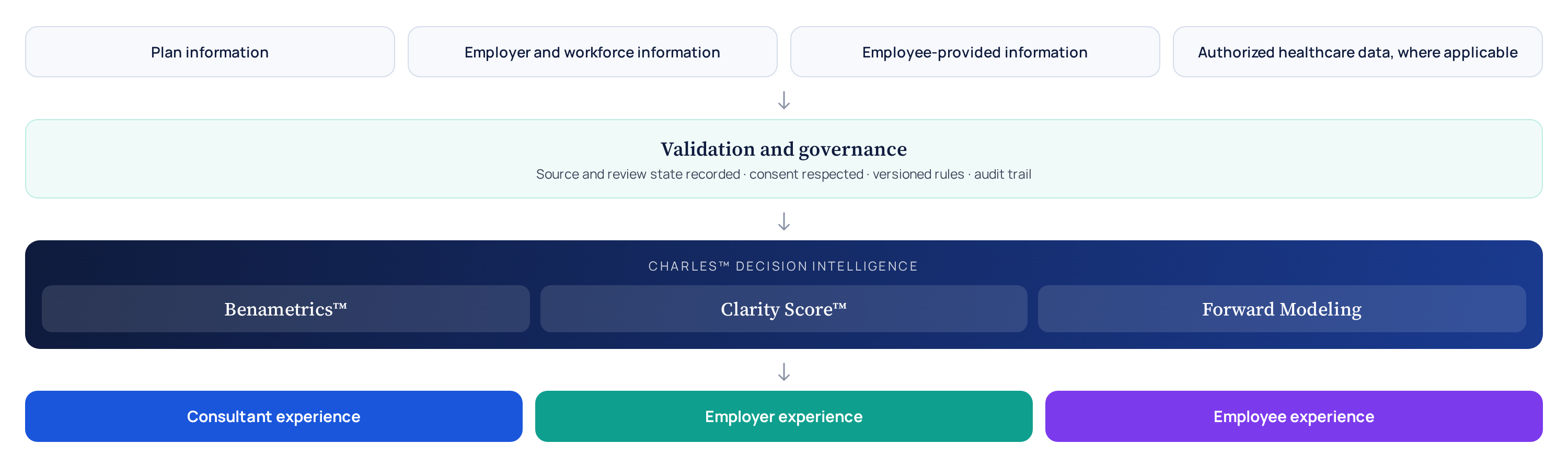
Structures the factors used to evaluate benefits strategy and plan fit. Rules and versions remain visible, governed, and reviewable.
A consistent analytical foundation
Translates complex comparisons into understandable guidance while keeping alignment and data confidence distinct.
An explanation layer, not a black box
Lets teams compare structured scenarios and document assumptions before a strategy becomes a real-world decision.
A governed view of possible directions
Three connected experiences
Every role works from the same governed platform, while seeing only the information appropriate to its responsibility.
Bring employer context, plan information, governed analysis, and client-ready findings into one engagement view.
Understand participation and decision patterns in aggregate while preserving the privacy boundary around individual inputs.
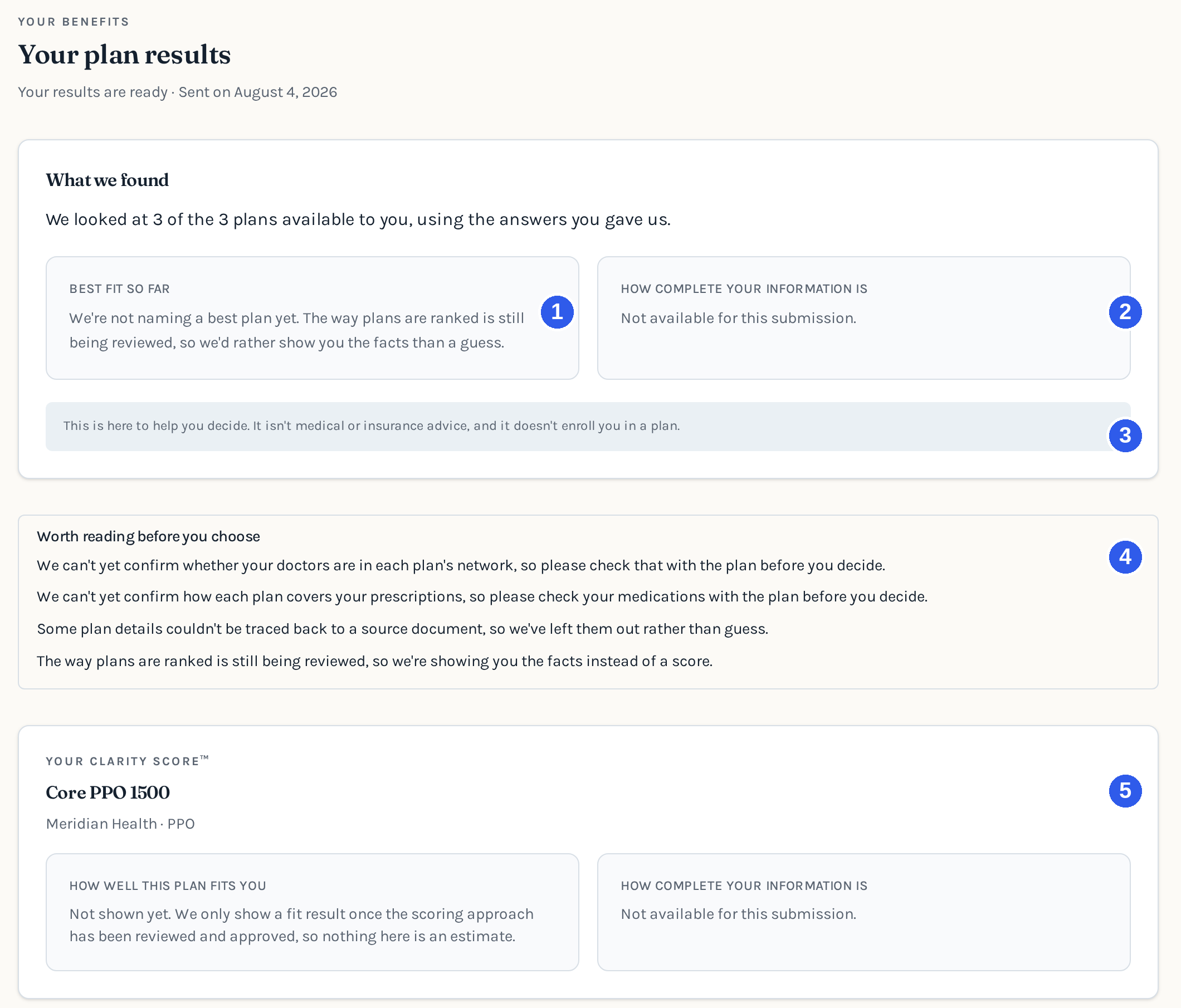
Compare plans against household preferences in plain language, with assumptions and missing information clearly stated.
Clarity without oversimplification
CHARLES gives employees plain-language comparisons and keeps assumptions, missing information, and confidence visible. It supports an informed benefits decision without giving medical advice or predicting a diagnosis.
Trust is part of the result
CHARLES is designed so that privacy, evidence, and governance are not afterthoughts. They shape how every result is produced and presented.
The three decision experiences share a controlled foundation rather than operating as disconnected tools.
Employers and consultants receive aggregate insights — never an employee’s individual health inputs.
Rules, assumptions, and configuration are traceable. Unvalidated weights cannot silently create a result.
Alignment and data confidence are reported separately, and unavailable values are never presented as zero.
CHARLES™ Insights
Clear, source-backed perspectives on decision intelligence, responsible AI, privacy, and interoperability.
A practical definition of benefits decision intelligence, how it differs from benefits administration, and why explainability matters.
Read articleWhy benefits information, accountability, and employee context become disconnected—and what a governed decision process can change.
Read articleA practical boundary for using AI to explain benefits choices without diagnosing, recommending treatment, or hiding the basis for an answer.
Read articleA better benefits decision begins with a connected view
Helping consultants, employers, and employees make informed, confident benefits decisions.